
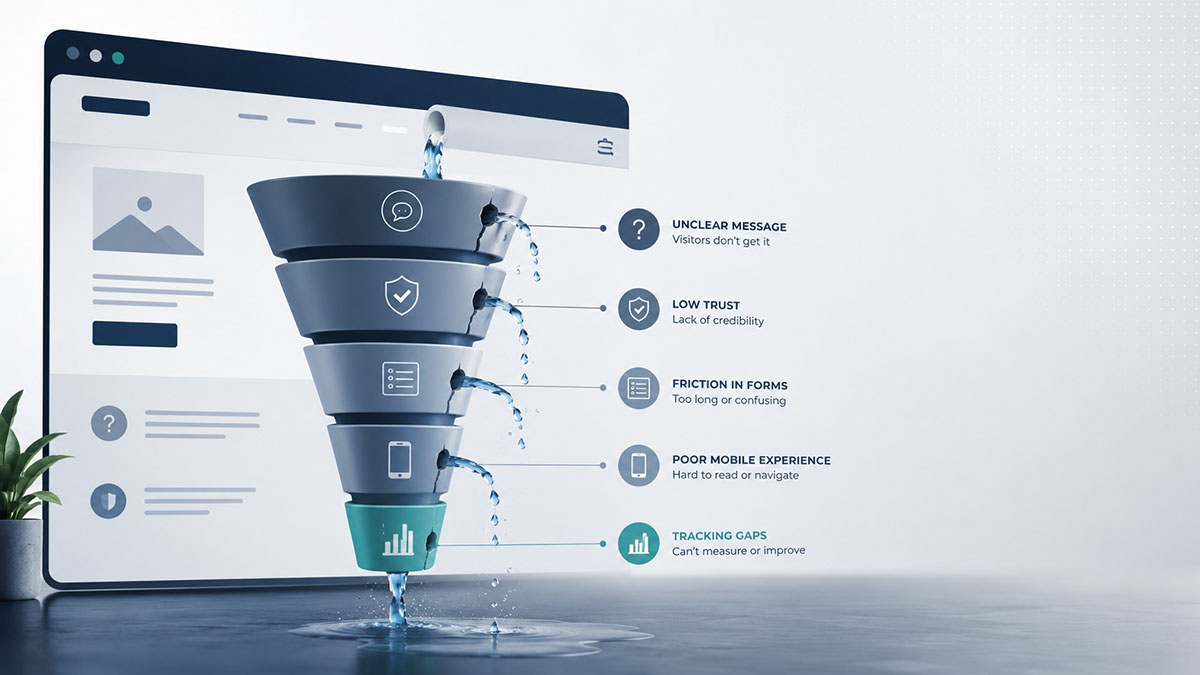
A website can look professional and still generate very few qualified leads. The problem is not always traffic. In many cases, visitors reach the site but cannot quickly understand what the business offers, why they should trust it or what they should do next.
Before you redesign the homepage or increase advertising, separate the problem into two parts. First, determine whether the right people reach the website. Then find out what happens after they arrive.
That distinction matters. More traffic will not fix weak messaging, broken forms or a confusing mobile experience. At the same time, a strong website cannot generate leads from visitors who were never likely to buy.
Start by Defining a Real Website Lead
A website lead is not every click, form entry or phone tap. It is a meaningful inquiry from someone who may fit the service, location, timing and budget the business can support.
Therefore, your website should not only increase response volume. It should help the right prospects understand the offer and take an appropriate next step.
For a local service company, that may be a phone call, estimate request or emergency-service form. A professional organization may need consultation requests, appointment inquiries or membership actions. A multilocation business may need the visitor to choose the correct location before contacting the team.
If the desired action is not clear, the website cannot support it consistently.
The Website Does Not Explain the Offer Quickly Enough
Many homepages use broad language that could describe almost any company. Phrases about quality, service and commitment do not tell a visitor whether the business handles the specific problem they need solved.
A strong opening should answer three questions quickly:
- What does the business provide?
- Who does it serve?
- What should a qualified visitor do next?
The answer does not need to fit into one sentence. However, visitors should not have to search through several sections or menu items to understand the basic offer.
Service pages matter for the same reason. A homepage introduces the business, while a focused service page explains the problem, scope, process and next step. Without those pages, search visitors and advertising traffic often land on content that is too general to support a decision.
The Website Creates Doubt Instead of Trust
Prospects compare your website with the other options they find. They may not know which company is technically best, so they use available signals to judge credibility.
Outdated copy, inconsistent branding, weak photography, broken links and missing details can make an established business look smaller or less dependable than it is. The same problem appears when a website contains bold claims but little explanation of the work, process or people behind it.
Trust usually comes from specific information:
- Clear service descriptions
- Accurate business and location details
- Original photos or useful visuals
- Verified reviews, credentials or examples where appropriate
- A clear explanation of what happens after contact
- Consistent information across the website and business listings
None of these elements guarantees a lead. Together, though, they reduce the uncertainty a prospect feels before reaching out.
The Conversion Path Is Hard to Use
A visitor may be ready to contact the business and still give up because the next step creates too much friction.
Common problems include forms that ask for unnecessary information, phone numbers that are difficult to find on mobile, vague buttons and pages with several competing calls to action. In other cases, the form submits without confirmation, sends to the wrong inbox or fails silently.
Test the conversion path as a customer would. Use a phone, not only a desktop computer. Complete the form, tap the phone number and review the thank-you page. Then confirm that the inquiry reaches the correct person and that someone follows up.
This simple test often reveals a larger issue: the website and the internal lead process were built separately.
Mobile Visitors Get a Weaker Experience
Many business websites were approved on a desktop screen even though a large share of prospects may first see them on a phone. Mobile problems can hide important content, shrink tap targets, create awkward forms or push the primary action far down the page.
A mobile review should cover more than whether the page technically fits the screen. Check whether the visitor can understand the offer, read the content, navigate the site and contact the business without zooming, searching or waiting through unnecessary effects.
Speed also affects the experience. A page overloaded with large images, scripts or poorly configured plugins can feel slow even when it eventually loads. However, speed scores alone do not diagnose the entire lead problem. The page must also be useful, relevant and easy to act on.
The Traffic and the Page Do Not Match
A website may receive visits from search, advertising, social media, directories and referrals. Each source creates different expectations.
Someone searching for emergency generator repair needs a different page from someone researching commercial maintenance contracts. Likewise, a paid ad about one service should not send every visitor to a general homepage.
When the page does not match the visitor’s reason for clicking, people leave. The ad may still report traffic, while the website produces few qualified inquiries.
Review the pages that receive the most traffic. Then compare the search terms, ads or referral sources that bring visitors there. A mismatch often points to one of two fixes: improve the page or stop sending the wrong traffic to it.
The Website Has No Reliable Conversion Tracking
Some websites generate more leads than the reports show. Others record button clicks or page views as if they were qualified inquiries.
Without tested tracking, leadership cannot tell the difference.
At minimum, the business should know whether important forms submit successfully and whether phone or email actions can be measured appropriately. Advertising campaigns may also require dedicated conversion actions, call tracking or landing-page reporting.
Tracking does not create demand. Still, it helps the business avoid making expensive decisions based on incomplete information.
Before changing the design, confirm what data is available and whether it can be trusted.
The Business Is Trying to Fix Everything at Once
Website projects often grow because every stakeholder has a different request. One person wants a new design. Another wants more pages. Someone else wants SEO, faster performance, new photography and a different form.
Some of those changes may help. Yet a long wish list does not establish the right order.
Start with the failures closest to the lead:
- Test forms, calls and lead routing.
- Confirm that conversion tracking records the right actions.
- Clarify the offer and primary next step.
- Fix the most important mobile and usability problems.
- Improve the service or landing pages receiving valuable traffic.
- Add trust signals and supporting content.
- Address broader design and technical improvements.
This sequence may change after an audit. Even so, it keeps the business from investing first in cosmetic work while critical lead paths remain broken.
How to Diagnose the Problem With the Information You Have
You do not need a perfect analytics setup to begin. Start with a few practical checks.
Ask the team what types of leads come through the website and which pages prospects mention. Review recent form submissions for quality. Search for the company from a phone and follow the same path a customer would. Compare the site with credible competitors, focusing on clarity rather than visual trends.
Next, review traffic and landing-page data if it exists. Look for pages with meaningful visits but weak engagement or few actions. Finally, check whether the business can connect calls and forms to a source with reasonable confidence.
The goal is not to collect every possible metric. It is to identify where the customer journey stops.
When a Website Review Makes Sense
Professional help becomes useful when the business cannot isolate the cause, when several systems are involved or when the website supports valuable services that justify a more careful process.
A website review should examine the structure, messaging, mobile experience, conversion path, technical setup and tracking. It should also distinguish between repairs, focused landing-page work and a full rebuild.
Rebuilding is not always necessary. Sometimes the business needs clearer service pages, tested forms, stronger calls to action and better measurement. In other cases, the underlying platform or structure limits every improvement.
Fix the Lead Path Before Buying More Traffic
A website should help a qualified prospect understand the business, trust the offer and take the next step. When that does not happen, more traffic often increases cost without solving the problem.
Arkutha can review your website’s structure, messaging, mobile experience, conversion path and technical setup to identify what should be fixed first. Request a website review before committing to random design changes or a larger traffic budget.
FAQs
The visitors may not match the offer, or the page may lack clear messaging, trust, relevance and an easy next step. Tracking problems can also hide real leads or count weak actions as conversions.
A page can repeat one primary action in several useful locations. Problems arise when several competing actions make the next step unclear.
Not always. Focused repairs to service pages, forms, mobile usability, messaging and tracking may solve the most important problems. A review should determine whether the platform or structure requires a rebuild.
Track meaningful actions such as qualified form submissions, phone interactions and other steps tied to the business. Test the setup regularly and avoid treating every click as a lead.
SEO can bring more relevant visitors, but it cannot replace a clear offer, credible content and usable conversion path. Search and website improvements need to support each other.
Review important lead paths whenever forms, campaigns, services, locations or technical systems change. A broader review is also useful when performance declines or the site no longer reflects the business.