
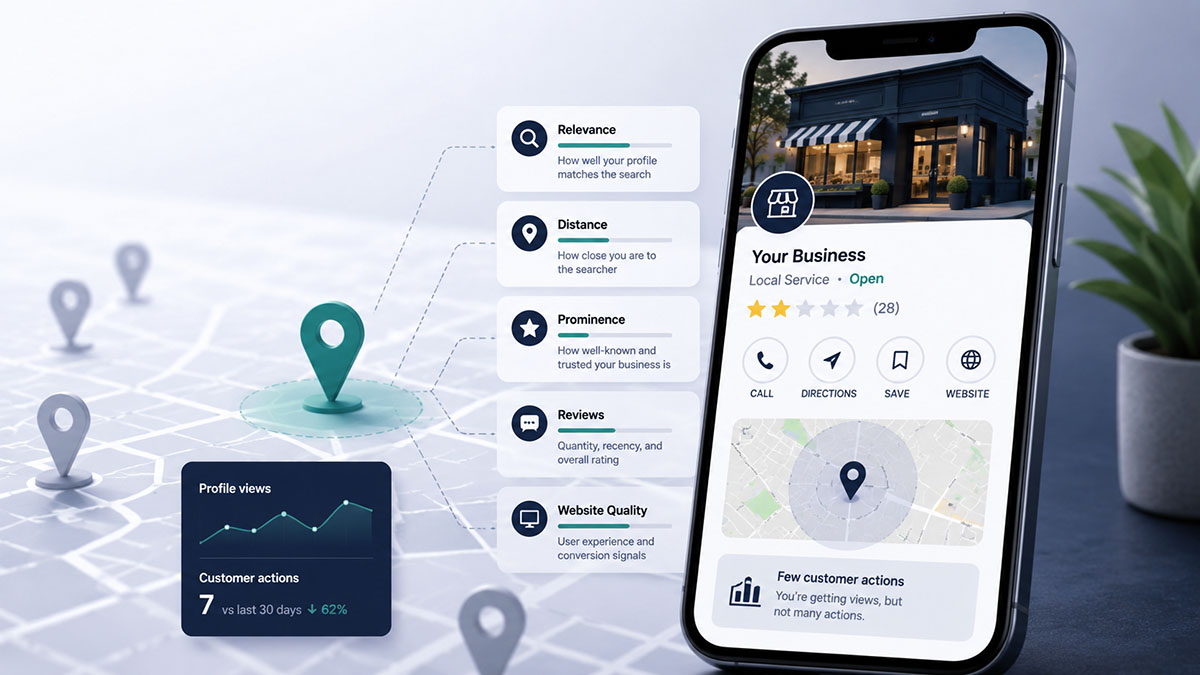
Creating or verifying a Google Business Profile does not guarantee that customers will find or choose the business. The profile may appear for branded searches and still produce very few calls, website visits, direction requests or qualified inquiries.
However, that does not always mean the profile is broken. Local visibility depends on how well the business matches a search, where the searcher is located and how established the business appears. Then, once the profile earns attention, the information and reputation signals must give the customer a reason to act.
In other words, a Google Business Profile is not a standalone marketing system. It works with the website, reviews, business information, local listings and the real-world strength of the company.
Local Visibility Is Not Based on One Setting
Google explains that local results are mainly based on relevance, distance and prominence. Those factors work together, which is why two people can search for the same service and see different businesses.
Relevance reflects how well a profile matches what the person is searching for. Distance considers the location of the searcher or the location used in the search. Prominence relates to how well known or established a business appears.
You can improve parts of the profile and the broader local presence. However, you cannot change the physical distance between the business and every potential customer. You also cannot buy a better local ranking from Google.
This is why profile work should begin with realistic expectations and a review of the full local search environment.
The Business Information Is Incomplete or Inconsistent
Customers need accurate information before they can contact or visit the business. Google also recommends complete and detailed business information to help it understand and match a profile to relevant searches.
Review the core details:
- Official business name
- Primary and secondary categories
- Address or approved service-area setup
- Phone number
- Website
- Regular and special hours
- Services
- Business description
- Relevant photos
Accuracy matters more than trying to insert extra keywords. Promotional language in the business name, incorrect locations or categories that do not match the actual operation can create policy and trust problems.
In addition, consistency extends beyond the profile. The website, major listings and customer-facing materials should not show conflicting phone numbers, addresses or hours.
The Categories Do Not Match the Work Customers Need
Categories help describe what the business is. A broad or incorrect primary category can make the profile less relevant to valuable searches.
Choose the category that best represents the main business rather than every service it might provide. Then use additional categories where they accurately reflect real offerings.
The profile’s service information should also support that choice. However, adding a long list of loosely related services will not solve a weak category strategy.
For multi-location businesses, each location also needs accurate categories and services. Copying an inconsistent setup across several profiles can multiply the problem.
The Website Does Not Support Local Relevance
The website linked from the profile gives customers and search systems more context about the business. If the site contains only a general homepage, it may not clearly explain the services, locations or service areas connected to the profile.
A local service business usually needs useful service pages and clear geographic information. A multi-location company may need a structured page for each real location. Those pages should provide original information instead of swapping a city name into repeated copy.
The website should also make contact easy. When a profile sends visitors to a slow, outdated or confusing page, visibility may not turn into leads.
Therefore, profile optimization and website work should not be treated as separate projects when they affect the same customer journey.
Reviews Are Weak, Inconsistent or Poorly Managed
Reviews influence how customers evaluate the business. Google also identifies review count and score as factors that may support local ranking.
The goal is not to chase a perfect rating or use shortcuts. A sustainable review process asks real customers for honest feedback and makes it easy for the team to respond appropriately.
For example, look beyond the average score. Review recency, volume, content and response patterns. A competitor with current, detailed reviews may look more active and dependable than a business with a similar rating but little recent feedback.
Responses matter because they show that the business pays attention. Still, every response should sound like it came from the company. Repetitive templates and keyword-heavy replies can feel artificial.
Never offer incentives or use review practices that conflict with platform rules. When a review appears fraudulent or violates policy, follow the available reporting process rather than arguing with the customer publicly.
The Profile Is Visible but Does Not Persuade Customers
Ranking and conversion are different problems.
For instance, a profile may appear in local results, yet customers choose another company because its information is clearer, its photos look more credible or its reviews better address the service they need.
Compare the profile with the businesses customers see beside it. Look at:
- The clarity of the category and service information
- Review quality and recency
- Photo quality and relevance
- Business hours and response options
- Website quality
- The consistency of the overall brand
Do not copy competitors blindly. Instead, identify the questions their profiles answer more effectively.
Original photos can help customers recognize the business, team, vehicles, location or work. However, use images that accurately represent the company. Stock photos may fill space, but they rarely provide the same proof.
The Business Is Targeting an Unrealistic Area
Meanwhile, service-area businesses often assume that adding many cities to a profile will create strong visibility across the entire region. That is not how distance works.
A company may serve a broad territory while remaining more visible near its actual location or where it has stronger relevance and prominence. Competition also changes from one city to another.
Service-area settings should describe where the business legitimately operates. They should not replace location pages, local content, listings, reviews or a broader regional strategy.
Multi-location businesses face a different challenge. Separate eligible locations may support distinct profiles, but each one requires accurate information, management and a useful destination page.
Google or Users May Have Changed the Profile
Over time, Google may update business information using several sources, including user reports and other available data. That means profile owners should review changes rather than assume the listing will remain untouched.
Watch for altered hours, categories, phone numbers, website links and attributes. Also confirm that the correct people retain access to the profile. Former employees or vendors should not remain the only owners of an important business asset.
If the profile becomes suspended, disabled or difficult to verify, avoid creating duplicates as a quick workaround. Document the business information and use the official support or appeal process that applies to the issue.
How to Diagnose a Weak Google Business Profile
First, start with the customer experience. Then move into visibility.
- Search for the business name and confirm that the correct profile appears.
- Review the profile from a phone while signed out of the managing account.
- Test the phone number, website link, directions and hours.
- Compare the primary category, services, photos and reviews with credible competitors.
- Review profile performance data for calls, website actions and other available interactions.
- Check whether the website supports the same services and locations.
- Search from several legitimate customer locations to understand how visibility changes.
- Review major listings for inconsistent business information.
Do not judge the profile from one search performed at the office. Local results can vary by location and query.
What to Fix First
Correct inaccurate or policy-sensitive information first. Next, improve the profile’s relevance and customer experience.
A practical order is:
- Confirm ownership and verification.
- Correct the business name, category, phone, website, address or service area.
- Update regular and special hours.
- Improve service information and business description.
- Add accurate, useful photos.
- Build a consistent review-request and response process.
- Improve the linked website and relevant local pages.
- Clean up important listings and monitor future changes.
The exact order may change when the business has several locations or a serious profile issue.
Your Profile Is One Part of Local SEO
A Google Business Profile can create valuable visibility, but it cannot carry the entire local strategy. The strongest approach connects accurate profile information with a useful website, consistent listings, credible reviews and pages that explain the services and locations customers care about.
Arkutha can evaluate your profile, website, local visibility, listings, content and competitors to identify the issues limiting your search presence. Request an SEO review if the profile exists but does not produce the visibility or qualified inquiries the business needs.
FAQs
The profile may have limited visibility, weak relevance, inaccurate information or a customer-conversion problem. Review local rankings, categories, reviews, photos, the website and whether the phone number works correctly.
Verification allows the business to manage the profile and confirm information, but verification alone does not guarantee strong local ranking or customer action.
Google states that local results are mainly based on relevance, distance and prominence. Complete information, accurate categories, reviews and a strong broader web presence can support parts of that picture.
A service area describes where the business operates, but it does not remove the effect of distance or competition. Broader visibility usually requires a complete local strategy.
Review it whenever hours, services, locations, contact information or ownership changes. Also monitor Google updates and keep photos, reviews and customer-facing details current.
Only eligible, real locations should have separate profiles. Multi-location businesses also need consistent management, accurate information and useful website pages for each location.