
When a dealership’s Google Ads aren’t performing, the knee-jerk response is almost always the same: spend more.
More budget. More impressions. More clicks.
But what if the problem isn’t the budget at all?
For one multi-brand dealership group running Google Ads across three separate websites, the issue had nothing to do with spend — and everything to do with structure, tracking, and alignment. Here’s how proper Google Ads optimization for dealerships transformed their account performance by more than 475%, without touching the budget.
Table of Contents
- The Client: Three Brands, One Account
- The Problem: Where the Performance Was Breaking Down
- The Solution: A Full Google Ads Optimization
- The Results: 1% CTR to 5.75%
- Key Takeaways for Dealerships Running Google Ads
- Frequently Asked Questions
The Client: Three Brands, One Google Ads Account
The client was a multi-brand dealership group operating three distinct web properties under one Google Ads account:
- Automotive sales
- Golf cart sales and rentals
- Trailer sales and services
Each brand had its own website, audience, and inventory – but all three were being managed inside a single Google Ads account with no clear structure separating them. Campaigns were running, budget was flowing, and traffic was coming in.
The leads, however, weren’t.
The Problem: Where the Performance Was Breaking Down
Before beginning any Google Ads optimization, we conducted a full account audit across all three web properties. What we found was a compounding set of issues across three layers: campaign structure, conversion tracking, and website performance.
The demand was there. The account just wasn’t structured to capture it.
Campaign Structure Issues
- Campaigns were scattered across three brands with no clean separation or budget logic
- Click-through rate (CTR) was sitting at roughly ~1% — a clear signal that ads weren’t resonating with searchers
- Smart Campaigns and Performance Max were running alongside manual search with no defined strategy
- Keyword overlap between brands was diluting ad relevance and wasting spend
Tracking & Measurement Gaps
- Conversion tracking was incomplete and inconsistent across all three websites
- Google Tag Manager contained duplicate and conflicting tags
- GA4 events were misfiring or not tracking key actions
- Phone clicks, lead form submissions, and contact actions weren’t separated by brand or website
- Without clean data, there was no reliable way to know which campaigns were actually generating leads
Website & Landing Page Problems
- Pages loaded slowly due to heavy, unoptimized images and CDN delivery issues
- Inventory pages were basic gallery layouts with no conversion pathway
- Navigation didn’t clearly route users between the three dealership brands
- There was no alignment between search intent, ad copy, and the landing pages users arrived on
The core issue: The market demand was there. The infrastructure wasn’t built to capture it.
The Solution: A Full Google Ads Optimization
Step 1 — Campaign Restructure & Cleanup
We audited every active campaign — trailers, golf carts, competitor/dealer targeting, Smart Campaigns, and Performance Max — and rebuilt the account structure from the ground up.
Key actions included:
- Separating campaigns cleanly by brand (Brad Benson Motorsports, 925 Golf Carts, East Bay Trailers)
- Eliminating campaign overlap that was splitting budget and diluting relevance
- Tightening keyword intent to match actual buyer searches for each product category
- Redirecting budget away from low-intent placements toward higher-converting search terms
- Reviewing and restructuring Performance Max asset groups for cleaner audience signals
Step 2 — Tracking & Conversion Foundation Rebuild
Accurate measurement is the backbone of any successful PPC management for dealerships. Without it, optimization is guesswork.
We rebuilt the measurement layer across all three sites:
- Audited and cleaned up Google Tag Manager on every web property
- Validated GA4 event tracking and removed duplicate/conflicting tags
- Implemented proper phone click tracking across all three brands
- Set up lead form conversion tracking separated by website and brand
- Configured Google Ads conversion import from GA4 for cleaner in-platform reporting
For the first time, the business had a real view of which campaigns, which websites, and which actions were driving actual value.
Step 3 — Website & Conversion Issues Flagged
While Google Ads optimization was the primary scope, we also identified and documented the website-level issues that were quietly undermining paid performance — including:
- Page speed issues caused by unoptimized image delivery
- Inventory pages lacking clear calls-to-action or conversion paths
- Disconnected navigation between the three dealership brands
- Vendor/platform limitations affecting customization and speed
These were delivered as a prioritized recommendation set to guide next steps beyond the ad account itself.
The Results: 1% CTR to 5.75%
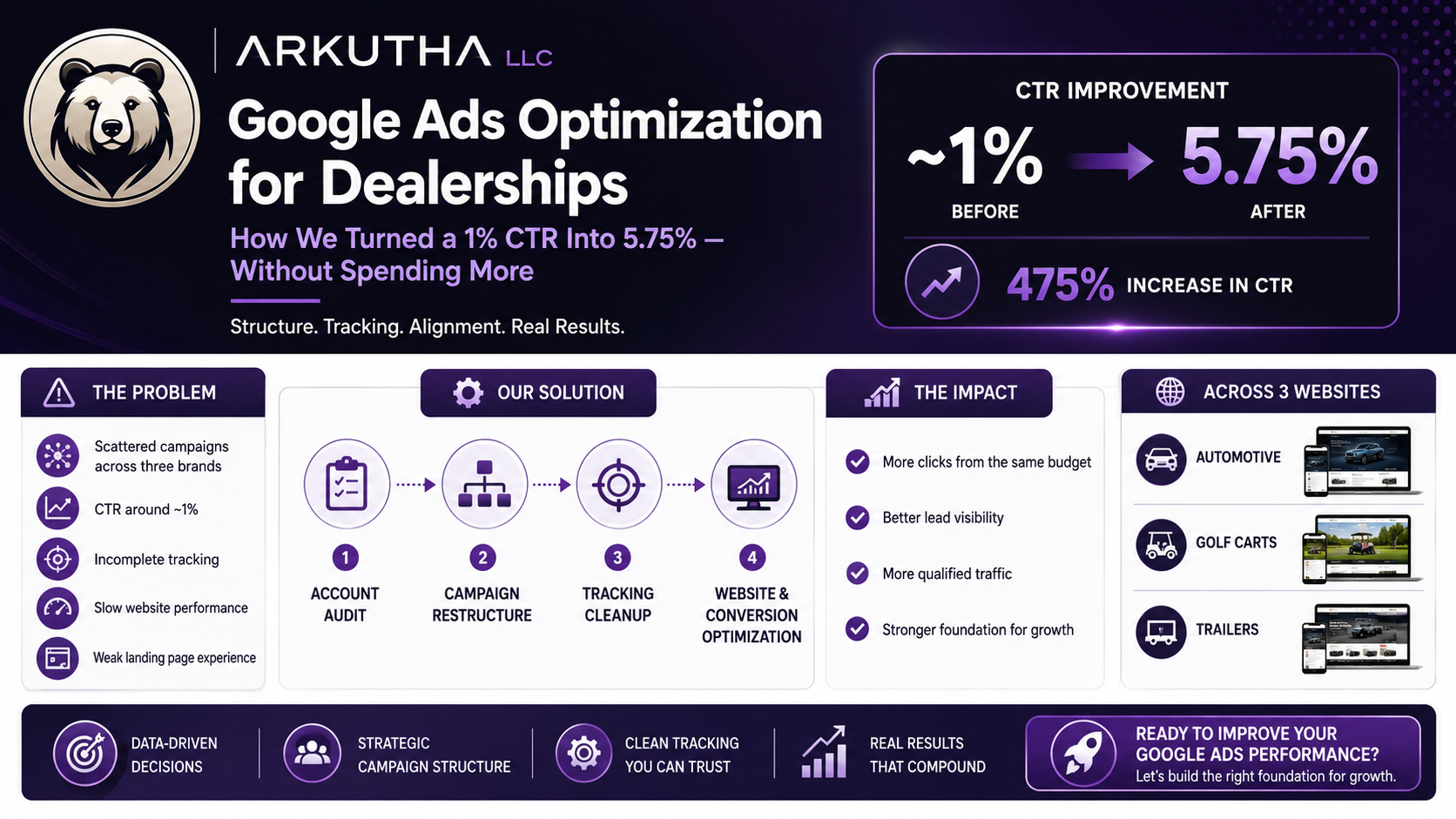
Within the engagement window — and without any increase to ad spend — average CTR across all three web properties improved dramatically.
| Metric | Before Optimization | After Optimization |
|---|---|---|
| Average CTR (All 3 Sites) | ~1% | ~5.75% |
| Improvement | — | +475% |
A nearly 5x improvement in click-through rate is a significant signal. It means more of the right people — people actively searching for what these dealerships sell — were seeing the ads and choosing to click.
This result confirmed what the audit suggested from the start: the demand was always there. The account just wasn’t structured to capture it.
Better structure → better ad relevance → better CTR → more qualified traffic into the funnel.
Key Takeaways for Dealerships Running Google Ads
This case study reinforces several core principles of effective Google Ads management for dealerships — especially those running multiple brands or product lines.
1. Structure before spend. A messy account will waste budget no matter how much you add. Fix the structure first.
2. Tracking is not optional. If you can’t measure leads by source, brand, and action type, you’re flying blind. Tracking cleanup is often the highest-ROI step in any Google Ads audit.
3. Ads and landing pages are a pair. A well-written ad pointing to a slow, confusing, or irrelevant page will always underperform. Keyword-to-landing-page alignment is non-negotiable.
4. Multi-brand accounts need clear separation. When trailers, golf carts, and motorsports all share the same campaign structure and budget pool, none of them win.
5. CTR is a health signal. A 1% CTR isn’t just a vanity metric — it tells you that your ads aren’t matching searcher intent. It’s one of the first places to look when an account feels “broken.”
What Could Have Come Next
With CTR at nearly 5.75% and a clean tracking foundation in place, the account was positioned to scale. The logical next steps would have included:
- Search Terms analysis and negative keyword expansion to eliminate irrelevant clicks
- Budget reallocation between trailers, golf carts, and competitor campaigns based on actual lead data
- Conversion-focused landing pages built specifically for each brand and product category
- Inventory page restructuring to support both paid and organic traffic
- A long-term content strategy connecting ads, SEO, social, and video under one system
When all of those pieces work together, dealerships don’t just improve CTR — they build a full lead generation engine.
Frequently Asked Questions
How long does a Google Ads optimization take for a dealership?
A full audit, restructure, and tracking cleanup for a multi-brand dealership account typically takes 3–6 weeks. Initial performance improvements, like CTR gains, can often be seen within the first 30 days.
Will optimizing my Google Ads campaigns require increasing my budget?
Not necessarily. Many of the biggest performance gains come from improving structure, tightening keyword targeting, and fixing tracking — not from spending more.
What is a good CTR for Google Ads in the automotive or dealership industry?
Industry averages for automotive search ads typically range from 3%–6%. A CTR below 2% is generally a sign of poor keyword-to-ad alignment, weak ad copy, or structural issues in the account.
Why is conversion tracking so important for dealership Google Ads?
Without accurate tracking, you have no way to know which campaigns, keywords, or ads are actually generating leads — including phone calls, form fills, text clicks, or direction requests.
What’s the difference between Smart Campaigns, Performance Max, and Search campaigns for dealerships?
Search campaigns give you the most control over keywords and targeting. Performance Max uses Google’s automation across multiple placements. Smart Campaigns are basic and offer the least control. For dealerships with multiple brands, Search campaigns usually provide the cleanest structure and control first.
Ready to Optimize Your Dealership’s Google Ads?
If your Google Ads account is running but not delivering the leads your inventory deserves, the problem is probably fixable — and it probably doesn’t require a bigger budget.
Arkutha LLC specializes in Google Ads management and optimization for dealerships, multi-location businesses, and brands with complex account structures.
We audit what’s broken, fix the foundation, and build toward results you can actually measure.