
A local business can have a capable team, strong service and plenty of demand nearby, yet still struggle to appear when customers search. Sometimes the Google Business Profile is incomplete. Other times, the website does not clearly explain which services are available in each market. And even when people find the company, they may not know how to get in touch.
Local SEO in 2026 is not a one-time profile setup. It is ongoing work across business information, the website, reviews, location signals and lead measurement. The goal is to help nearby customers find the right business and take the next step, not to promise a top ranking in every city.
What determines who appears in local search?
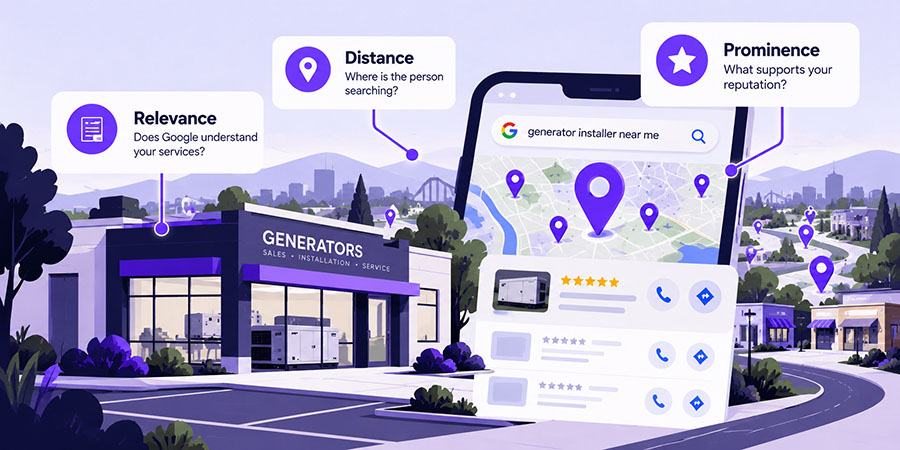
Google says its local results are mainly based on relevance, distance and prominence. Its local ranking guidance also states that businesses cannot pay for a better organic local ranking. These factors explain why improving a profile is useful but does not put every result under a business’s control.
Relevance: Does Google understand the service?
A business profile needs to describe what the company actually does. Its website should reinforce that information. An electrical contractor offering panel upgrades, generator installation and commercial service should make those services easy to distinguish. Broad claims such as “quality solutions” tell customers much less.
Distance: Where is the person searching?
Search results can change from one neighborhood to another. A contractor may serve several counties, but adding those counties to its profile does not make distance disappear. Service-area settings should reflect real operations, not places added merely to reach more searches.
Prominence: What supports the business’s reputation?
Google points to information such as links, reviews and positive ratings when describing prominence. The useful response is to build a credible business presence, not to chase artificial citations or assume a handful of reviews guarantees a ranking.
Is the Google Business Profile complete and accurate?
For many customers, the profile is their first introduction to the company. It may show hours, services, contact information, reviews and directions before they reach the website. An error there can create confusion even if the company ranks well.
Start with the information that can be checked against real business operations:
- Official business name and appropriate categories
- Address visibility or service-area configuration
- Current phone number, website and hours
- Services, useful photos and relevant business attributes
- Who owns and can update the profile
Google’s guidelines for representing a business require the profile to reflect the real company. Do not add keywords to a business name or use an unstaffed virtual office as a shortcut to another city. A service-area company and a walk-in storefront may need different setups.
Does the website explain the services and markets clearly?
The profile helps customers discover the business. The website has to support their decision. A prospect who clicks through should quickly see the relevant service, the area covered, proof the company can do the work, and an obvious contact option.
That is why an SEO and local visibility review should inspect both the profile and the website rather than treat them as separate projects.
Service pages need more than a list of keywords
Consider a generator company with installation, preventive maintenance and emergency repair services. A useful page for each meaningful service can explain who it serves, what the work involves, which areas are covered and how to request help. One general page listing dozens of services may leave buyers with unanswered questions.
Location pages need actual local information
Regional and multilocation businesses may need separate pages for real offices or important service markets. Each page should help a customer in that area, with accurate contact information, services available there and location-specific details where they exist. Do not publish dozens of pages that only swap the city name.
Google’s people-first content guidance favors material that provides original value for readers rather than pages produced chiefly to manipulate rankings. A useful location page should stand on its own for a real customer.
What role do reviews and business listings play?
Reviews can influence both customer trust and local visibility. Google says review volume and positive ratings can help local rankings. That does not mean a business should pressure customers or manufacture a perfect-looking review profile.
Ask real customers for honest feedback and respond professionally. Google’s Maps review policy prohibits paying for reviews, selectively requesting only positive feedback and other rating manipulation.
The same practical approach applies to listings. Correct outdated phone numbers, closed locations and duplicate information on major directories and relevant industry sites. The goal is accurate information where customers actually look, not a high count of weak directory entries.
Can technical website problems hold back local SEO?
Yes. A strong service page does little for search if an important URL cannot be crawled or is accidentally set to noindex. Website changes can also leave old redirects, broken links, conflicting canonical tags or unhelpful navigation.
A focused technical review should check:
- Whether important service and location pages are indexable
- Internal links from navigation and related pages
- Page titles, headings, redirects and canonical URLs
- Mobile usability and page-loading problems
- Sitemaps, duplicate pages and broken contact paths
Accurate LocalBusiness structured data can help describe factual details such as a location’s address and hours when implemented appropriately. It is not a ranking guarantee, and markup must match the business information customers can see.
Are local search visits turning into qualified inquiries?
A map position or search ranking is only one indicator. Business owners also need to know what happens after the click. More profile views will not repair a broken quote form, a missed call or a page that attracts the wrong type of inquiry.
Useful reporting can bring together search visibility, landing pages, calls, forms and lead quality. Look for patterns by service and by location rather than relying on one average number for the company.
If those numbers cannot be connected, an analytics and conversion tracking review can help establish which actions are recorded, which are missing and where reporting is unreliable. A phone-number click, for example, does not prove a qualified call took place.
What should a local business fix first?
The right order depends on what is already working. A company with a suspended profile has a different problem from a regional contractor whose profile is accurate but whose service pages are vague. For most established businesses, this is a sensible starting sequence:
- Correct inaccurate business information and confirm profile ownership.
- Check the profile categories, hours, service areas and primary contact details.
- Make the highest-value services and real operating locations clear on the website.
- Repair major indexing, mobile and contact-form failures.
- Build a steady, policy-compliant review process and correct important listings.
- Measure qualified calls and forms, then revisit the pages and markets that need work.
An internal team can usually confirm business facts, gather real local photos, identify common customer questions and test whether forms reach the right people. Technical search problems, multilocation governance and unreliable lead tracking may require coordinated professional support.
Does AI-assisted search change the fundamentals?
People can now discover companies through maps, conventional results and AI-assisted answers. That creates additional places where a business may be described, but it does not justify abandoning the basics. Our article on website readiness for AI search explains why clear services, crawlable pages and accurate public information remain useful foundations.
There is no universal setting that guarantees a business will appear in an AI answer. Keep the facts consistent and make the website useful to actual customers first.
When should a business request a local SEO review?
A review makes sense when the company serves valuable local markets but cannot explain why certain services or locations are hard to find, why profiles contain conflicting information, or whether search visibility is producing useful leads. The business needs prioritized findings, not a long list of disconnected tactics.
Arkutha helps local and regional companies evaluate the connected website, profile, content, listing and measurement issues behind local search. Request an SEO review to identify what deserves attention first.
Frequently asked questions
Does adding more cities to a service area improve rankings?
Not by itself. A profile’s service area describes where the business operates. Google still considers distance and other signals, so results may vary from one searcher to another.
Do reviews help local SEO?
Google says review count and positive ratings can help local ranking. Reviews also help buyers judge the business. Ask real customers for honest feedback without incentives or pressure.
Does every service location need a separate web page?
Not automatically. Real offices and significant markets may benefit from pages that answer location-specific questions. A copied page with only a different city name adds little value.
Can a strong Google Business Profile replace the website?
No. The profile can support discovery, but customers often need deeper service information, qualifications and clear contact paths before they decide.
How should local SEO performance be measured?
Review visibility alongside meaningful calls, completed forms, relevant landing pages and lead quality. No single ranking or traffic metric can explain the entire result.